What Legal AI Should Not Automate
· Benvolio Team

Legal AI has evolved rapidly, moving beyond research and document review into more complex domains of legal analysis and decision-support. While automation promises efficiency, consistency, and scale, legal practice remains defined by judgment and accountability.
Understanding the limits of legal AI is primarily a professional exercise, not a technical one. Certain legal tasks depend on judgment, accountability, and jurisdiction-specific context that cannot be safely delegated to automated systems without increasing vulnerability.
Why Automation Boundaries Matter in Legal Practice
Legal work is not a neutral process. Legal advice, interpretation, and decision-making carry professional and potential responsibility. When legal outcomes are contested, responsibility rests with the organization or the lawyer, not with the technology that creates it.
Automation creates vulnerability when it obscures accountability or unwarranted confidence. Systems designed for speed or pattern recognition may generate results that appear legally sound but lack contextual grounding or doctrinal rigor. As a decision increases its legal and commercial significance, so does the cost of relying on automation.
Clearly defined boundaries for automation act as safety measures for professional integrity, legal certainty and trust. Maintaining these boundaries ensures that technology supports expert judgment.
Legal Interpretation Should Not be Automated
Interpreting the law is not purely a mechanical or technical exercise. It requires professional judgment, hierarchy of legal norms, institutional practice, and jurisdiction-specific principles. Even where statutes are not ambiguous, their application often depends on context.
Legal AI systems operate by identifying patterns in text, they do not reliably capture why a court favors one interpretation over another in a given context, or how institutional dynamics shape enforcement. Automating legal interpretation therefore risks flattening nuances into generalized and decontextualized outputs.
When interpretation is automated, errors may remain invisible until challenged, and that is the point they become professional issues, rather than technical ones.
Legal Advice and Final Conclusions Must Remain Human-Led
Legal advice is an exercise of professional judgment, requiring weighing risk, understanding client objectives, and anticipating consequences.
Automating final legal conclusions shifts responsibility without eliminating liability. While AI may generate confident recommendations, confidence is not a substitute for defensibility.
The same rule applies to ethical responsibility too, meaning it must remain visible, accountable, and human.
What Legal AI Should Do Instead
Legal AI is most effective when used to:
- support legal reasoning without replacing professional judgment.
- organize, structure and retrieve legal information.
- surface relevant issues and inconsistencies.
- improve visibility, consistency, and efficiency within legal workflows.
When designed around these principles, legal AI reinforces professional judgment and strengthens legal practice.
A Product Designed to Support These Needs
Benvolio is designed as a legal intelligence platform built around these principles. Across its products, the focus is on supporting structured legal analysis without automating professional judgment or shifting responsibility away from legal teams.
Rather than generating final conclusions, Benvolio tools are designed to make legal reasoning more visible, consistent, and defensible within real legal workflows.
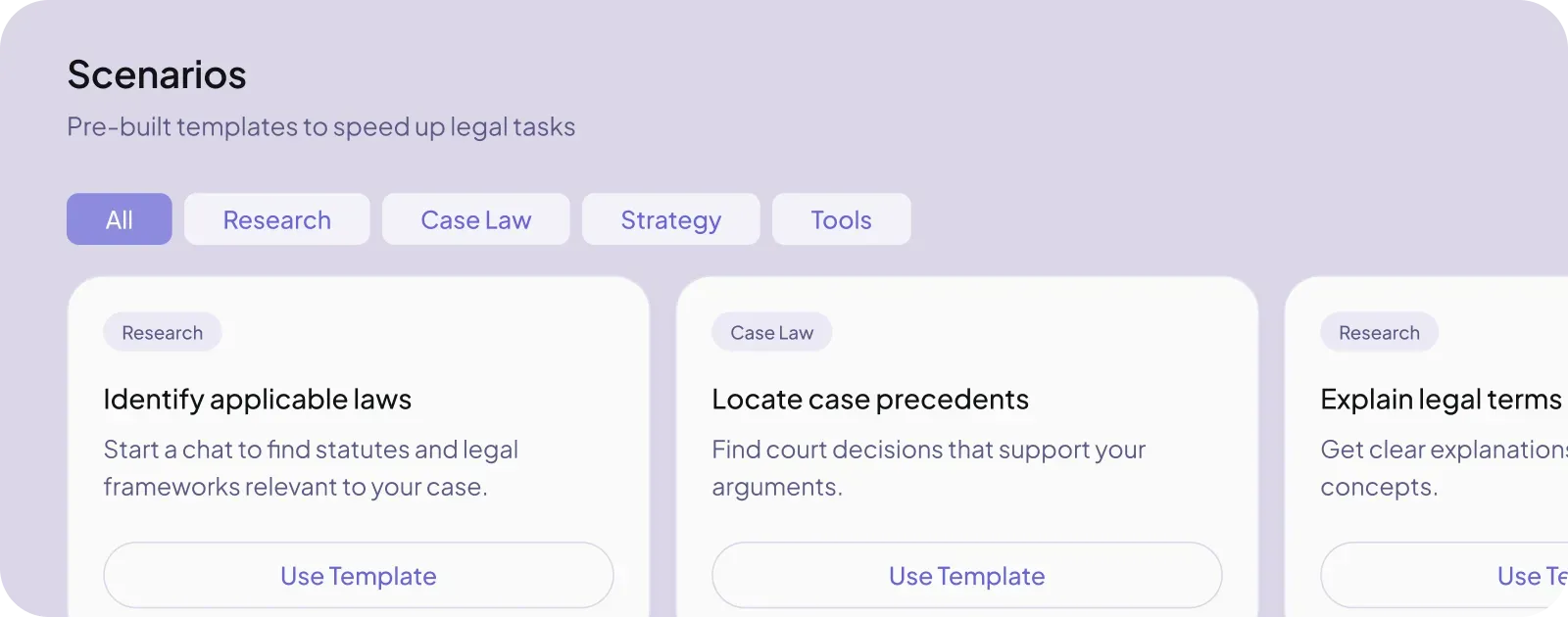
Scenarios is one example of this approach in practice.
This product supports structural legal analysis in recurring legal matters. In practice, Scenarios can:
- provides common legal scenarios and matter templates, enabling faster orientation into typical case types.
- standardizes how legal questions are framed across teams and jurisdictions.
- helps legal teams organize and scope issues early, reducing repetitive reasoning without automating final judgment.
- integrates into broader legal workflows alongside research, drafting, and review tools.
Final Takeaway
Legal AI delivers value when it respects the boundaries of legal judgment.
Interpretation, legal advice, vulnerability balancing, ethical decisions, and accountability-bearing actions should not be automated, because these are the areas where responsibility, context, and professional discretion are essential.
The future of legal AI will not be defined by what it replaces, but by how effectively it supports legal professionals in making decisions they can explain, justify, and defend later.
References and Where to Learn More
- Council of Europe Framework Convention on Artificial Intelligence and Human Rights, Democracy and the Rule of Law
- Article 14 of AI act: Human oversight
- European lawyers in the era of ChatGPT. Guidelines 2.0 on how lawyers should take advantage of the opportunities offered by large language models and generative AI